


Zakończył się aktywny udział polskich marynarzy w misji SNMCMG1

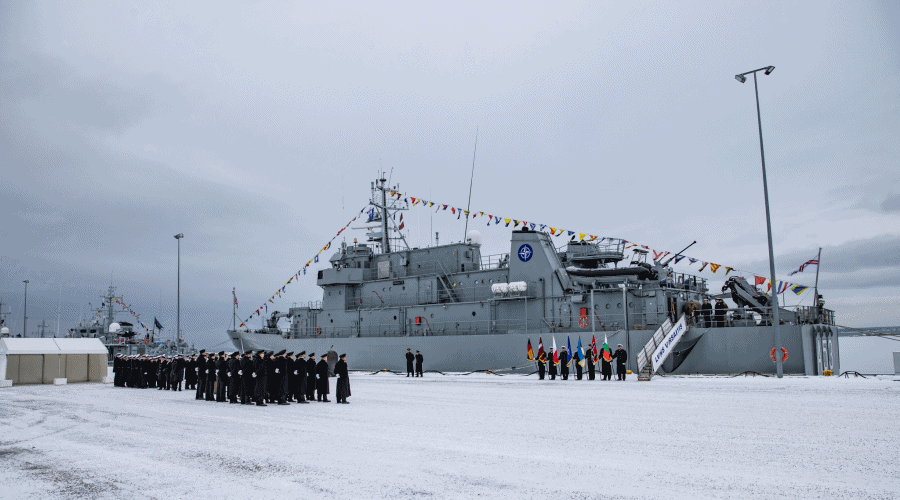
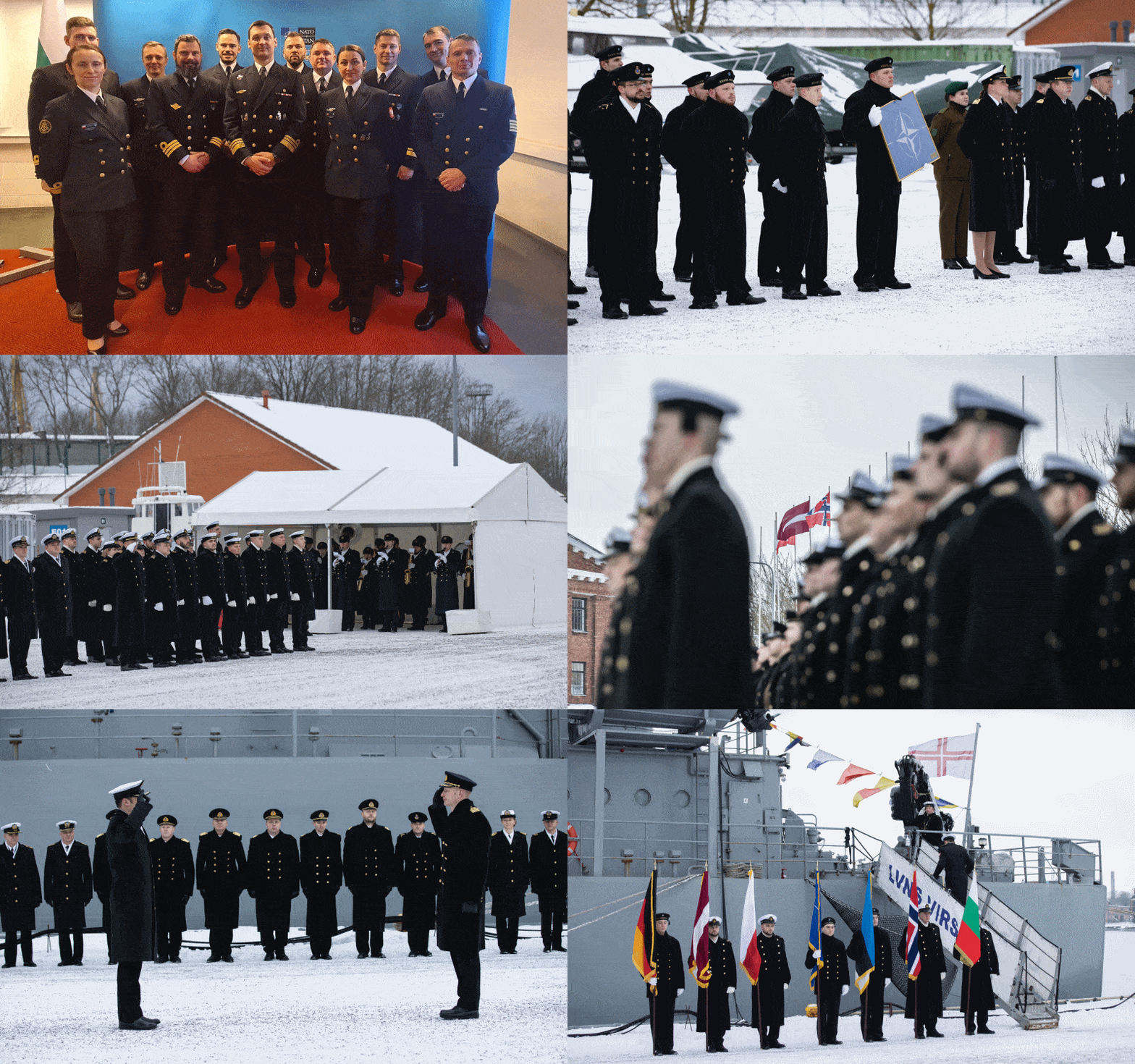
W środę, 12 stycznia, komandor porucznik Michał Dziugan przekazał dowodzenie Stałym Zespołem Sił Obrony Przeciwminowej NATO Grupa 1 oficerowi estońskiej Marynarki Wojennej. Tym samym zakończył się aktywny udział polskich marynarzy w misji PKW Morze Północne. Ceremonia przekazania obowiązków odbyła się w stolicy Estonii, Tallinie.
Po raz czwarty w historii oficerowi Polskiej Marynarki Wojennej powierzono dowodzenie jednym z czterech zespołów okrętów Sojuszu Północnoatlantyckiego, utrzymywanych na morzu w stałej rotacyjnej służbie. Komandor porucznik Michał Dziugan od 2 października 2021 roku stał na czele pierwszej z grup przeciwminowych NATO i wraz z międzynarodowym sztabem przez ostatnie miesiące kierował działaniami okrętów tzw. „Tarczy Przeciwminowej” Sojuszu. Trzon sztabu stanowili oficerowie i podoficerowie wydzieleni z jednostek 8. Flotylli Obrony Wybrzeża wspierani przez oficerów z Bułgarii, Estonii i Norwegii. Uroczystość zdania obowiązków odbyła się w Tallinie, w Estonii. Obowiązki dowódcy zespołu przejął estoński oficer – komandor porucznik Ott Laanemets, który wraz ze swoim sztabem będzie dowodził SNMCMG1 z pokładu łotewskiego okrętu flagowego LVNS „Virsaitis”.
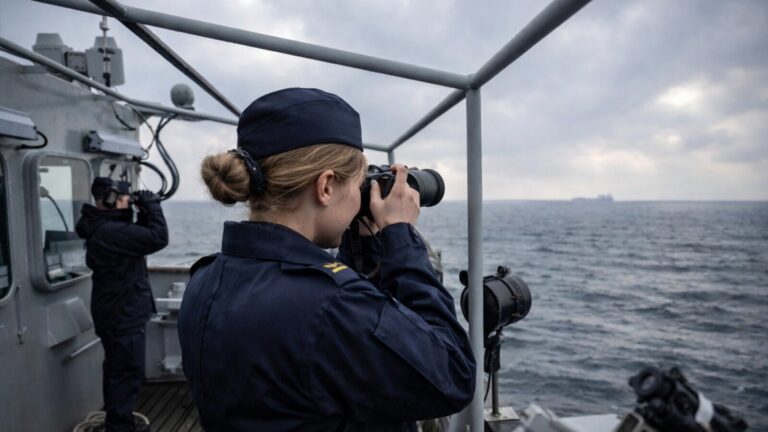
Polscy marynarze zostali zaokrętowani na pokładzie niemieckiego okrętu flagowego FGS „Elbe”. Tam sformowali Polski Kontyngent Wojskowy Morze Północne, którego zadaniem było dowodzenie Stałym Zespołem Sił Obrony Przeciwminowej NATO Grupa 1 (ang. Standing NATO Mine Countermeasures Group 1, SNMCMG1). Po raz pierwszy w historii polski sztab kierował działalnością NATOwskiego zespołu z pokładu niemieckiego okrętu. W trakcie misji pod polskim dowództwem oprócz okrętu flagowego FGS „Elbe” operowały rotacyjnie niszczyciele min z Belgii BNS „Primula”, Holandii HNLMS „Vlaardingen”, Łotwy LVNS „Talivaldis”, Niemiec FGS „Homburg” i „Bad Bevensen” oraz Norwegii HNoMS „OlavTryggvason”, a także dwa niemieckie drony typu Seehund.
Fot. Estonian Defense Forces
Głównym zadaniem okrętów Stałego Zespołu Sił Obrony Przeciwminowej NATO, na czele którego stali Polacy jest zapewnienie bezpieczeństwa żeglugi na morskich szlakach komunikacyjnych poprzez poszukiwanie, wykrywanie i niszczenie niebezpiecznych obiektów podwodnych stanowiących powojenne pozostałości. Ważnym aspektem misji była również demonstracja i akcentowanie obecności Sojuszu w regionach kluczowych dla wspólnego bezpieczeństwa poprzez tzw. prezentację bandery, czyli wizyty w portach zarówno sojuszniczych, jak i krajów partnerskich spoza NATO. W trakcie misji międzynarodowy zespół odwiedził łącznie 14 portów w 10 różnych krajach. Okręty trzykrotnie wizytowały także Polskę, zawijając do portów w Świnoujściu, Szczecinie i Gdyni.
Działalność PKW Morze Północne rozpoczęła się 17 września 2021 zanim jeszcze doszło do objęcia dowodzenia nad SNMCMG1 przez polski sztab. Przez pierwsze dwa tygodnie na pokładzie FGS „Elbe” marynarze ściśle współpracowali ze sztabem składającym się z żołnierzy amerykańskich, podczas jednego z największych ćwiczeń morskich NATO pk. Joint Warrior/DynamicMariner ’21, które odbywało się na Atlantyku w północnych rejonach Wielkiej Brytanii. Był to czas kiedy polski sztab przygotowywał się do płynnego przejęcia obowiązków po poprzednikach. Uroczystość przejęcia dowodzenia nad Zespołem z rąk amerykanów miała miejsce 2 października ub. r. w Belfaście, w Irlandii Północnej. Już niespełna dwa tygodnie po objęciu obowiązków zrealizowano pierwszą bojową operację. Okręty zespołu wzięły udział w operacji usuwania niewybuchów z okresu II wojny światowej zalegających na dnie Morza Północnego. Operacja pod nazwą Beneficial Cooperation prowadzona była na wodach terytorialnych Holandii i Belgii. Na początku listopada przeprowadzono wspólne manewry z polską Marynarką Wojenną w ramach drugiej edycji operacji morskiej pod kryptonimem Solidarna Belona. W tym czasie zespół zrealizował operację przeszukania toru podejściowego do portu w Świnoujściu tzw. HODOPS (ang. Historical Ordnance Disposal), jak również szereg epizodów szkoleniowych z jednostkami świnoujskiej 8. Flotylli Obrony Wybrzeża. W ramach integracji sił morskich i lądowych Sojuszu zorganizowano wspólne ćwiczenia z saperami wielonarodowej Batalionowej Grupy Bojowej NATO stacjonującej na Litwie podczas postoju okrętów SNMCMG1 w porcie Kłajpeda. Ponadto w trakcie trwania misji Sztab organizował m.in. ćwiczenia mające na celu utrzymanie wysokiego poziomu wyszkolenia zespołu i zdolności do natychmiastowego reagowania oraz działania. Prowadzono treningi wewnątrz zespołu oraz ćwiczenia dwustronne z siłami morskimi państw na których akwenach przyszło zespołowi operować. Łącznie na pokładzie okrętu dowodzenia obsada PKW pokonała blisko 7000 mil morskich operując w północnej części Atlantyku oraz na Morzu Północnym i Morzu Bałtyckim.
Autor: kmdr ppor. Grzegorz Lewandowski/Oficer Prasowy/Stały Zespół Sił Obrony Przeciwminowej NATO Grupa
1Zdjęcia: Estonian Defense Forces
Why European Frigate Programmes Struggle – and What Distinguishes the Few That Don’t

As European navies modernise their surface fleets, frigate programmes have become a litmus test for industrial governance, risk management and institutional maturity. Recent experience across the continent suggests that outcomes are shaped less by ambition or technology than by when and how complexity is confronted.
W artykule
Frigate Programmes Under Pressure: Structural Patterns Rather Than National Exceptions
Across major naval procurement programmes, frigate construction has increasingly been associated with schedule slippage, cost escalation and declining delivery confidence. This pattern is visible across several Western navies and reflects persistent structural pressures in how modern surface combatants are designed, contracted and brought into service.
In recent years, parliamentary oversight and official assessments have made these dynamics unusually transparent. In some cases, programmes advance physically-modules assembled, steel cut, keels laid—while formal delivery confidence ratings indicate that successful completion remains uncertain without corrective action.
Rather than focusing on individual programmes as isolated successes or failures, a more illuminating approach is to analyse the structural conditions under which delivery confidence deteriorates—or is preserved: when risk is deferred, how integration is sequenced, and how national industrial governance shapes programme behaviour over time.
Delivery Confidence, Design Maturity and the Cost of Concurrency
One increasingly visible indicator of stress within naval procurement is the divergence between construction status and delivery confidence assessments. Situations have emerged where ships are already under construction, or even launched, while formal delivery confidence is categorised as red-indicating that, under current conditions, successful delivery appears unachievable without significant intervention.
This pattern is commonly associated with high degrees of concurrency: ship construction, workforce ramp-up, combat system integration and industrial modernisation advancing in parallel rather than sequentially. While such concurrency may appear to compress timelines, it also concentrates unresolved risk into the build and integration phases-precisely when options to adjust scope, sequencing or architecture are most constrained.
Public acknowledgements of inflationary pressure and integration risk, alongside assertions that programmes remain “in line with plans and forecasts”, illustrate a recurring tension: investment in facilities and integration capacity can mitigate risk, but also confirms that risk has not been eliminated-only displaced.
Reference Models and Diverging Outcomes
International experience suggests that the most persistent problems arise where three conditions coincide:
- incomplete design maturity at contract award,
- dispersed or evolving production arrangements,
- accelerated schedules that assume later integration will absorb early uncertainty.
In such cases, delivery confidence tends to erode even as visible progress continues.
By contrast, programmes that prioritise architectural stability, incremental capability introduction and firm control of scope before construction begins tend to display greater predictability over time. This does not imply technological conservatism, but a governance choice to constrain variance rather than optimise capability early.
Within Europe, several frigate programmes are now referenced as illustrations of different risk-management logics rather than as national exemplars.
Programme Maturity as a Structural Variable
In comparative analyses of recent European frigate programmes, differences in delivery outcomes increasingly appear to correlate less with national ambition than with accumulated programme maturity and institutional learning.
While individual programmes are often discussed in isolation, international experience suggests that delivery outcomes are rarely explained by single design decisions or isolated industrial measures. More often, they reflect accumulated programme behaviour: a sequence of architectural choices, governance practices and institutional learning built up over time.
Programmes that appear stable in execution tend to share a common characteristic: they are not abrupt departures from earlier work, but the result of iterative development across multiple generations of ships, organisations and supply chains. Their relative execution predictability is therefore less a function of novelty than of continuity.
Incremental introduction of new technologies, firm control of design baselines prior to construction, and avoidance of radical mid-build modifications consistently emerge as decisive factors. Where such practices are embedded over long periods, they become organisational habits rather than ad‑hoc risk mitigations.
Certain European programmes are increasingly referenced in this context-not as outliers, but as illustrations of how sustained investment in digital design, systems engineering and integration discipline can translate into comparatively predictable execution, albeit within tightly governed frameworks that leave limited room for late-stage deviation.
British Type 31: Progress Without Corresponding Confidence
The United Kingdom’s Type 31 frigate illustrates the tension between physical progress and delivery confidence. Despite visible milestones-launch events, modular construction and expanded shipyard capacity-official assessments in late 2025 assigned the programme a red delivery-confidence rating, indicating that successful delivery could not be assumed without corrective action.

Fot. Babcock Internationale A substantial investment in shipyard modernisation and shore-based integration facilities has been presented as a mitigating measure. However, the juxtaposition of a red confidence rating with ongoing construction reflects a familiar structural pattern: concurrency sustains momentum while increasing the internal concentration of risk.
The French FDI Programme: Discipline With Structural Constraints
The French FDI frigate programme is often cited as evidence that schedule and cost discipline remain achievable in modern frigate construction. This assessment is broadly accurate but requires nuance.

The relative predictability of FDI is based on a highly centralised governance model, strong design authority and strict scope control. These characteristics have limited design churn and supported execution stability. At the same time, they limit elasticity: configuration divergence and sovereign modification are feasible but procedurally demanding.
Thus, FDI represents a model of low variance but low elasticity: predictable and coherent, but less accommodating of rapidly evolving requirements.
Spanish F110 frigate: Importance of the industrial system
The Spanish F110 frigate is one of the cases frequently cited in recent comparative analyses. Its development did not begin with the current hulls but is based on a long sequence of surface‑combat programmes that progressively reduced uncertainty rather than accumulating it.
This suggests that programme maturity must be understood not only at the level of an individual ship, but also at the level of the industrial system that produces it. Where that system has already absorbed the learning curves associated with complex integration, subsequent programmes begin from a fundamentally different risk position.

Seen from this perspective, contracting decisions are less about selecting a platform than about selecting an industrial trajectory-one in which predictability is the cumulative result of methodical, long-term effort rather than accelerated optimisation.
The Polish Miecznik Programme: Deferred Decisions, Rising Costs
Poland’s Miecznik frigate illustrates a less forgiving variant of the same structural dynamic. Although based on an existing design line, the programme has been characterised by repeated revisions to cost assumptions, shifts in delivery timelines and an extended pre‑contract phase that has significantly shaped its risk profile.

Open-source reporting and official disclosures indicate that the total programme value has increased substantially compared with initial estimates, with successive contract modifications reflecting evolving scope, system choices and industrial arrangements. Delivery milestones have likewise shifted to the right as design completion and industrial mobilisation advance.
These developments do not indicate programme failure. Rather, they suggest that risk has not been eliminated but redistributed. In Miecznik’s case, a significant portion of that risk appears to have emerged early through renegotiations and baseline revisions, rather than later through formal delivery‑confidence warnings. As a result, the programme enters its construction and integration phases with less schedule margin and greater sensitivity to sunk cost than originally envisaged.
The German Case: Modular Ambition Under Fragmented Governance
Recent German frigate programmes add another dimension to the European landscape. Despite access to one of Europe’s most capable naval industrial bases, outcomes have been repeatedly shaped less by technology than by governance structure.
The F125 frigate entered service only after considerable delays and extensive post‑delivery remediation. Its successor, the F126, has so far shown familiar symptoms: cost increases, schedule delays and prolonged decision chains, despite the involvement of the experienced Damen Shipyards Group as prime contractor.

Fot. Bundeswehr / Carsten Vennemann The German case is instructive because it removes simple explanations: even where design philosophies emphasise reuse and modularity, outcomes remain highly sensitive to clarity of design authority and sequencing discipline. Without these, complexity is not removed-it is merely displaced.
Implications for Decision-Making
Taken together, recent European experience suggests that the decisive variable in frigate programmes is not ambition, but when risk is absorbed.
- Risk deferred to construction and integration phases is the least reversible.
- Risk addressed earlier limits options but preserves delivery credibility.
However, from a Central and Baltic European perspective, the challenge increasingly concerns time. The strategic environment in the Baltic Sea region continues to evolve faster than naval modernisation cycles allow, giving priority to early operational availability over theoretical final capability.
For neighbouring allies approaching major surface‑combatant decisions, including Sweden and Denmark, recapitalisation delays are therefore not a purely national concern. They affect the entire region, shaping deterrence, interoperability and collective resilience.